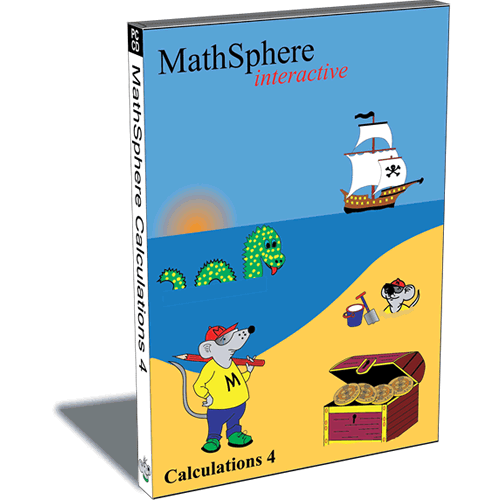
A practical, easy to use resource covering Knowing and Using Number Facts and Calculating for Year 4. With over 100 separate activities, timed challenges and games, this is an indispensable classroom resource.
Ideal for the teacher to use on electronic whiteboards. Perfect for the children to practise and consolidate.
Full account has been taken of the renewed Primary Framework for Mathematics which was implemented in January 2007.
Full content
If you were wondering if there was much on this CD - be assured that the Primary Framework for Mathematics has been covered in incredible detail. Each one of over 100 activities concentrates on just one concept....many include
step by step help files explaining what strategies to use. Using the CD, your children can develop the use of efficient written methods for addition and subtraction as well as developing written methods for multiplication and division.
Explanations of activities
Clear, step by step help files demonstrate the objectives and really help teachers explain the key concepts. Ideal for improving mental arithmetic skills.
High interest
Vivid, full screen illustrations and fast moving games capture children’s imagination, maintaining high interest.

Screen shots from Calculations Year 4
|
|
|
|
|
 |
 |
 |
Separate activities on the CD include:
Revise addition facts and strategies
- revise 2-digit addition
- understand the vocabulary of addition
- which two numbers have a total of…?
- complete written questions
- shopping
- number pairs that make 100
Addition of multiples of 10, 100 and 1000
- add two multiples of 100
- add two multiples of 1000
- add a multiple of 10 to a 3-digit number
- add a multiple of 10 to make 1000
- pairs of multiples of 50 that make 1000
- add multiples of 1000
- what must be added to … to make …?
Apply addition strategies
- relate subtraction to addition
- relate addition to subtraction
- relate addition to multiplication
- add several small numbers
- add 3 multiples of 10
Develop efficient written methods for addition
- add 2-digits to 3-digits
- 3-digit addition: least significant first
- add decimals (1)
- add decimals (2)
- efficient written methods: 2-digits
- efficient written methods: 3-digits
Revise subtraction facts and strategies
- revise 2-digit subtraction
- understand the vocabulary of subtraction
- complete number sentences (1)
- complete number sentences (2)
- subtract a larger number from a smaller number
Apply subtraction strategies
- find a difference either side of a multiple of 100
- subtract by counting back in tens
- subtract the nearest multiple of 10 and adjust
- subtract multiples of 100
- subtract 99
Further subtraction strategies
- subtract a single digit from a multiple of 1000
- subtract a single digit from any 3-digit number
- find a small difference either side of a multiple of 1000
Develop efficient written methods for subtraction
- revise subtraction by counting up
- subtraction by compensation
- subtraction by decomposition
- efficient written method for 2-digits
- efficient written method for 3-digits
Calculate doubles and derive halves
- double numbers up to 50
- double multiples of 10
- double multiples of 100
- identify near doubles
- double any multiple of 5 up to 100
- halve multiples of 10 up to 200
- divide by 4 by halving and halving
- halve 2-digit numbers
Revise understanding of multiplication
- multiplication as repeated addition
- multiplication as the inverse of division
- multiply by 1 or 0
- find the product
- multiplication and addition
Know tables by heart
- 6x table
- 7x table
- 8x table
- 9x table
- 10x table
- multiply by 9, 10 or 11
- recognise multiples of 9
Further multiplication strategies
- multiply 2-digits by 9
- multiply 2-digits by 11
- multiply by 4 by doubling twice
- multiply by 5 by multiplying by 10 and halving
- multiply by 20 by multiplying by 10 and doubling
- recognise multiples of 9
Develop and refine written methods for multiplication
- develop written methods (1)
- develop written methods (2)
- develop written methods: most significant digit first
- develop written methods: least significant digit first
Revise understanding of division
- understand the vocabulary of division
- know finding a half is the same as dividing by 2
- know finding a quarter is the same as dividing by 4
- divide by 10
- divide by 100
- relate division to multiplication
Understand remainders
- give a remainder as a whole number (1)
- give a remainder as a whole number (2)
- round down after division
- round up after division
- round to the nearest whole 100
Derive division facts
- divide by 6
- divide by 7
- divide by 8
- divide by 9
- divide by 10
- divide by 11
Begin to find fractions of numbers
- find one fifth
- find one tenth
- find fifths
- find tenths
- pairs of fractions which total 1
- find three quarters
- find one hundredth
Develop and refine written methods for division
- develop written methods (1)
- develop written methods (2)
Checking answers
- relationship between halving and doubling
- relationship between doubling and halving
- approximate by rounding
Use a calculator
- Single step calculations
- multiply decimals
- subtraction and negative numbers
- convert to pence
- 2-step calculations
Tables challenge